

After years of relentless searching for the ideal mobile app to effectively manage my finances, I encountered continuous challenges. Each app I experimented with seemed to have shortcomings—some lacked the flexibility I desired, others imposed a burdensome manual data input process, and quite a few failed to decipher spending data from SMS notifications automatically. The substantial monthly subscription fees only served to deter me further.
Ironically, it was not until I embarked on my entrepreneurial journey and launched my own company that I stumbled upon the perfect solution for optimizing profits, mitigating risks, and elevating the quality of financial decision-making: the MIS report. This revelation arrived as a seemingly simple yet remarkably potent tool—a spreadsheet.
Within the confines of this article, I shall lead you through crafting a potent MIS report. This tool holds the potential to revolutionize your financial outcomes for the better.
Significance of MIS Reports in Financial Decision-Making
The Management Information System (MIS) report is vital for effective financial management, whether in the corporate world or personal finance. It is a robust data aggregator and organizer, harmonizing information from diverse sources and presenting it in a structured, easily digestible format. This, in turn, facilitates a comprehensive examination of financial data, the identification of trends, and the facilitation of well-informed decision-making.
In the dynamic realm of business and personal financial matters, making prompt, precise decisions grounded in current and accurate information is paramount. A meticulously crafted MIS report offers a gateway to essential insights for business proprietors, financial analysts, and individuals alike. It plays a pivotal role in pursuing profit maximization, risk mitigation, and identifying avenues for enhancing financial well-being.
Key Elements of an Effective MIS Report
- P&L Summary: This section serves as the heart of your report, consolidating data from various income and expense sources. It offers a concise and holistic view of your financial landscape.
- Income Sheet: In this segment, you will find a breakdown of all your regular and supplementary sources of monthly income. Extra income may be presented separately for clarity and easy tracking.
- Monthly Expenses: This sheet provides a comprehensive breakdown of your fixed and variable expenses, projected for the upcoming year. It is intricately linked to the P&L summary, ensuring a unified perspective of your financial outlook.
- Transaction Ledger: An indispensable component, the transaction ledger meticulously records individual transactions. It plays a pivotal role in granular tracking and facilitates in-depth analysis of spending patterns over time.
These essential components work harmoniously to give you a holistic understanding of your financial well-being. They serve as invaluable tools for enhanced financial planning and more informed decision-making.
Visualizing Data in Your MIS Report
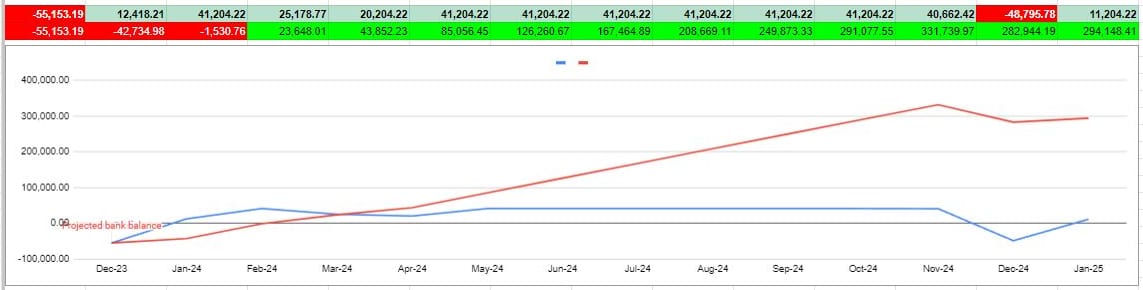
Now that we have meticulously organized our data, exploring its full potential is imperative. We can effortlessly pinpoint months characterized by cash deficits or surpluses by incorporating key metrics such as 'Gross Profit' and 'Projected Bank Balance' into our Management Information System (MIS) reports.
Besides these fundamental changes, including a dynamic line chart predicting the projected bank balance for the next 12 months proves invaluable. This chart, continuously updated with each new transaction or revised income/expense projection, is a powerful tool for visualizing and forecasting financial trends. It plays a pivotal role in facilitating more informed financial planning and decision-making processes.
Moreover, pie charts and bar charts have emerged as indispensable tools in budget management. They help us monitor expenditures, ensuring we remain within the budget.
In an MIS report, charts can serve many purposes beyond budgeting. Here are a few other use cases for the business:
- Sales Analysis: Charts can be employed to visualize sales trends over time, highlighting periods of growth or decline and aiding in sales strategy development.
- Customer Segmentation: Bar charts can be used to categorize customers based on various parameters, allowing for targeted marketing efforts and personalized customer experiences.
- Inventory Management: Charts can provide insights into inventory levels, helping optimize stock levels and reduce carrying costs.
- Quality Control: Visual representations of quality control data can help identify patterns and areas where product or service quality may need improvement.
- Employee Performance: Charts can be used to track and compare employee performance metrics, facilitating better human resource management and incentive programs.
- Market Research: When conducting market research, charts can make it easier to interpret and present data on customer preferences, market share, and competitive analysis.
In summary, charts within MIS reports are versatile tools beyond budgeting, offering valuable insights into various business operations and aiding in data-driven decision-making across multiple domains.
Analyzing and Interpreting the Data
A close look at a report is helpful because it allows us to see patterns, find ways to improve how we do things, figure out where we might be losing money, improve our budget plans, and make smarter money decisions. When you spend more time with your financial data, you start to see how things connect and get a clearer picture, which helps you make better money choices.
Keeping Your MIS Report Accurate with Regular Updates
Maintaining the accuracy of your Management Information System (MIS) report is crucial for effective financial management. The key to an up-to-date and precise report is consistently updating the transaction ledger. This chapter will explore how to streamline this process, reducing manual effort by automating transaction entries.
The Importance of Regular Updates
Before we delve into automation, let's highlight why regularly updating your MIS report matters. An accurate report provides a real-time snapshot of your financial situation, allowing you to make informed decisions promptly. It helps track expenses, identify trends, and ensure your budget remains on track. By diligently recording every transaction, you gain greater control over your financial health.
Automating Transaction Entries
SMS Integration: Many of us receive SMS notifications from our banks every time we use a credit or debit card. These notifications contain valuable transaction data, which can be automatically linked to your MIS report. By parsing these SMS messages and extracting the relevant information, you can effortlessly update your ledger with minimal manual effort.
Emails: Similarly, you can set up your email to forward transaction-related emails to a designated address or use email parsing tools to extract transaction details. This method can benefit online purchases or transactions that generate email receipts.
App Notifications: If you use financial apps or payment platforms, they often send transaction notifications. Apps like Tasker can be configured to automatically process these notifications and update your MIS report accordingly.
Bank Statements: Some banks provide downloadable transaction statements in electronic formats (e.g., CSV or Excel). These files can be imported directly into your MIS report, saving you the trouble of manual data entry.
Combining Automation Methods
To ensure that your MIS report remains consistently up to date, consider combining multiple automation methods. For instance, you can use SMS parsing for card transactions, email forwarding for online purchases, and a bank statement import feature for comprehensive coverage. This redundancy reduces the likelihood of missing any transactions and maximizes the efficiency of your financial record-keeping.
Conclusion
In this comprehensive guide, we've explored the power of Management Information System (MIS) reports and how they can revolutionize financial management. We began by emphasizing the importance of maintaining an accurate and up-to-date MIS report to make informed financial decisions promptly.
The article delved into the core components of an effective MIS report, including the P&L Summary, Income Sheet, Monthly Expenses, and Transaction Ledger, providing a structured framework to understand your financial health better.
One of the key highlights of this guide is the chapter on "Keeping Your MIS Report Accurate with Regular Updates." It outlined various methods to automate transaction entries, reducing the manual effort required. These methods included leveraging SMS notifications, email parsing, app notifications with the Tasker App, and importing bank statements. By combining these automation techniques, you can ensure that your MIS report remains consistently current.
Ultimately, mastering your finances with MIS reports and automation empowers you to track expenses, identify trends, and stay on top of your budget. This newfound financial clarity equips you to make informed decisions, minimize risks, maximize profits, and achieve better financial outcomes in both personal and business contexts.
If you're inspired by this article and considering creating your own MIS report, remember that you don't have to tackle it alone! I offer my expertise and assistance on Upwork to help you craft a personalized MIS report that can truly transform your life. Whether it's for personal or business use, I'm here on Upwork to guide you through the process and make it easier for you. Check out my Upwork offer here and take the first step towards gaining valuable insights from your data. Don't hesitate to reach out if you need any assistance – I'm just a message away!