I’ve wanted to write a book for a long time. I never found the time, and I didn’t want AI to write it for me, so the idea sat on the shelf for years. What finally moved it was something I didn’t expect: n8n, a library of other people’s automations I imported and never used, and my three kids. Together they turned into Smarter Way, a series of children’s books, and this is how it started.
Learning n8n by copying other people’s work
When I first got into n8n, I spent hours scrolling through its public library, several thousand workflows other people built and shared for free. I imported a lot of them. None was 100% what I was looking for, but that wasn’t the point. Opening someone else’s workflow shows you everything: which nodes they used, how they’re connected, where the data goes next. It was the fastest way to learn how n8n works and what’s even possible with it.
I went through productivity flows, then video editing flows that posted to TikTok and other platforms through Blotato, and very quickly I realised n8n is a really nice bridge between services. One step calls a language model, the next one calls an image service, the next one runs your own code. I also discovered tools I’d never heard of. WaveSpeed, for example, was sitting inside one of those imported workflows, and later I reused it in mine. It still draws our illustrations today.
None of those workflows ever made it to production. But all of them fed the idea behind Smarter Way.
Why I never wrote that book
Lack of time was the obvious reason. The other one was that I didn’t want AI to write my book, because that’s not my style. I never spent the time training ChatGPT, Claude or any other model on how I write, and honestly, I never believed it could get there 100%.
I’ll be fair here: I’ve done my share of AI-generated blog posts for SEO, and a handful of them are still live. I’ve read them, they’re okay-ish, but I’m not proud of them and I don’t enjoy reading them, so I stopped. If I had the time, I’d write every one of them differently.
So the book stayed an idea.
Why children’s books
I have three kids, and when they were small, finding good books for them was a pain in the ass, honestly. The books I grew up with always carried some kind of value. A lot of the newer ones I was reading to my kids felt very shallow.
While I was playing with all those n8n flows, the two ideas met: why don’t I create a children’s book? It made sense for two reasons. When I started, children’s illustrations were the thing AI did best, far better than anything else it could draw. And good books for kids are actually needed. I wanted books I’d be happy to read to my own kids, where they learn something and get some inspiration, with characters who are each different and who teach the good old things: courage, believing in yourself, love, family.
I also wanted something for every age: easy books with fewer words and more pictures for the little ones, and longer stories with more words and fewer pictures for older kids. A few from the shelf today:
The Boy Behind the Punchlines (audiobook). Jonah is the funniest kid in school, and his jokes fill every silence before anyone can ask why he eats leftovers alone most nights, until one of his lines lands on a quiet classmate instead of a laugh.
The Yes Girl Finds Her Voice (audiobook). Maya says yes to everything, because being easy to like feels safer than being seen, until one honest idea slips out at a club meeting and the room goes quiet.
Milo and the Magic Paper Planes (audiobook). Milo folds the fastest planes in class and keeps his trick to himself, until the class needs hundreds of planes for a fair and everyone else’s keep crashing.
The Little Bunny’s Quiet Song (audiobook). Bella thinks her voice is too small for the talent show, until a friend asks if she’d like to try it together.
Why one AI isn’t enough
I knew from the beginning that you can’t make a good book with one LLM. Ask a single model for a children’s book and you get an average one. Real publishing doesn’t work like that either: the person who decides who a book is for isn’t the person who draws it.
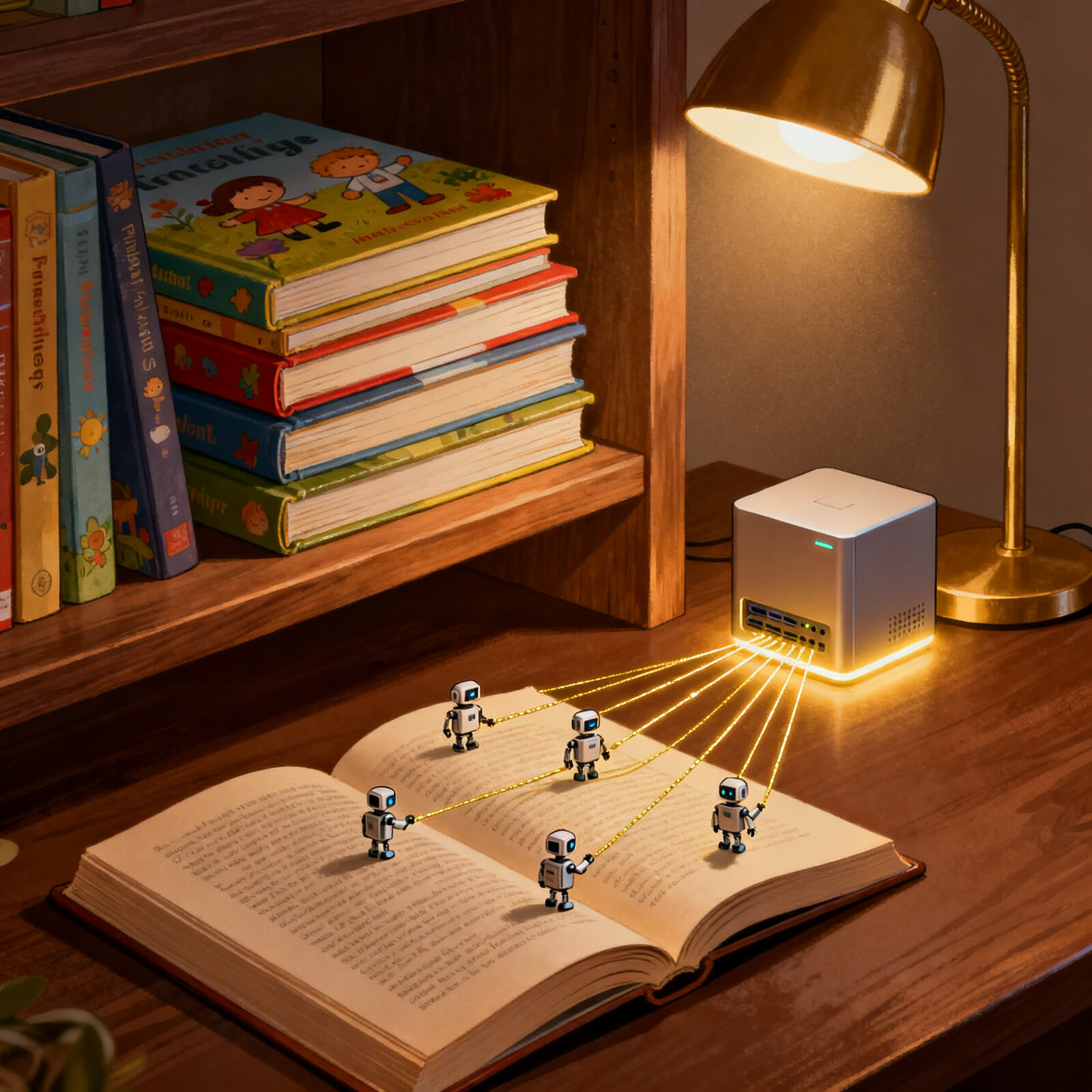
That’s what made n8n the right tool. I could build a small team of specialists and chain them together. The first one reads the story idea and decides the age group and the format: how many pages, how many words on each, how many pictures. The second designs the characters and the world they live in, and gives every character a card with their age, looks and relationships, which every later step has to follow, so a brother is still a brother on the last page. The third breaks the story into pages and writes the text. The fourth describes each scene in enough detail for an image model to draw it.
Then come the illustrations and the cover, and the final step, packaging it all into an EPUB, is done purely by code. Coding has always been my passion, and that’s what I loved most about n8n: I could mix several models, other tools and my own code in one system. The whole thing runs on my Synology NAS at home.
And then there’s translation, which is one of the coolest things about AI today. A finished book goes to another model, one that’s better with languages, and comes back in Polish, Arabic, Hindi and Chinese.
A person reads every book
None of this goes out to the world straight from the machine. I read the books myself, and Tuba, my assistant, checks every single page of every book, reads it, and fixes what needs fixing, so in a way she co-authors each one. AI still makes mistakes, especially in the pictures, and I want parents to know there’s real care behind every book, not just a button I pressed.
Free for the kids
The books are for sale, but I never wanted Smarter Way to be only about selling. The stories are also audiobooks, videos you can just press play on, and those are free for children on our YouTube channel, Smarter Way Stories. That turned out to matter more than I expected. Putting audiobooks out for free is what later pushed me to build Fablingo Academy, free language courses. But that’s a story for another day.
That’s how Smarter Way was born, from a library of workflows I never used, and the name says what I was after: meaningful books, made in a smarter way. Of course, not everything went smoothly after that, but that’s for the next chapter.